
Most readiness conversations start with the wrong question: what hardware do we need, what does IT have to build, how long is the capital cycle. That question stalls programs for a year at a time.
The better question is whether the conditions virtual nursing exists to fix are already showing up in your staffing reports. Below are the five that matter, why each one is a readiness signal rather than a staffing problem to absorb, and what to check in your own numbers this week.
Key Takeaways
Nursing leaders rarely lack evidence that something has to change. What is missing is the link between the numbers already on the monthly report and a model that addresses them. These five signs are that link.
01New Graduates Are Leaving Inside Year One
A new nurse who resigns in month nine almost never cites compensation. They cite being alone with a full assignment before they were ready, and a preceptor who was pulled into their own patient load by 10 a.m. Virtual nursing puts an experienced nurse on the other end of a camera for the questions that used to go unasked, a second license in the room without a second body on the floor.
Check the number by cohort, not by unit average. One Med-Surg unit losing four of its six new grads is invisible inside a house-wide figure.
What to pull this week
Twelve-month retention for every nurse hired in the last two years, split by unit and by shift. If night shift retention trails days by more than ten points, you have found the unit your pilot should start on.
02Agency And Travel Spend Keeps Climbing
Premium labor is the most honest measure of unmet demand in a nursing organization. It is also the line item that makes the virtual nursing business case straightforward: recovered internal hours are compared directly against purchased premium hours, in the same currency, on the same report.
The comparison a CFO responds to is not satisfaction. It is throughput and substitution. One virtual nurse covering admissions and discharges across a unit returns hours that were previously bought at agency rates.
03Admissions And Discharges Are Eating The Shift
Ask a charge nurse what breaks a good day and the answer is three admissions arriving during two discharges. Both workflows are documentation-heavy, both require a licensed nurse, and neither requires hands on the patient. That combination is the definition of transferable work.
| Workflow | Requires hands on patient | Avg. duration |
|---|---|---|
| Admission history and intake | No, transferable | 22 min |
| Discharge instructions and teach-back | No, transferable | 18 min |
| Shift handoff documentation | No, transferable | 9 min |
| Medication administration | Yes, stays bedside | 14 min |
| Rounding and physical assessment | Yes, stays bedside | 11 min |
If discharge orders written at 9 a.m. are still producing an occupied bed at 2 p.m., the constraint is not the physician and not housekeeping. It is a nurse who has not had twenty uninterrupted minutes since morning.
04Protocol Adherence Depends On Who Is Working
Sepsis screening, fall precautions, restraint documentation, CAUTI bundles: when audit results swing by shift or by weekend, the protocol is fine. The coverage is not. Consistency is a function of attention, and attention is the thing a unit runs out of first.
05A Pilot Started, And Then Quietly Stopped
This is the most common of the five and the least discussed. A unit ran a trial, the cameras are still mounted, and nobody formally ended it. Ask what stopped it and the answer is almost never bandwidth or hardware. It is that the virtual nurse's scope was never written down, so the bedside team was not sure what to hand over, and escalation ownership at 3 a.m. was left to goodwill.
The pilot did not fail on technology. It failed because two nurses each believed the other had called the provider, and after that nobody trusted the handoff.
 Marcia Murphy, MSN, RN, AGACNP-BC, ANP-BC, NE-BC, CCRN, CPHQChief Nursing Officer, Vitalchat
Restarting a stalled pilot: what changes
- Write the virtual nurse's scope on one page, and name one owner for each escalation type before go-live.
- Move one workflow only, admission intake, and leave it there until it is boring.
- Write the escalation protocol with night shift in the room, not handed to them.
- Measure a two-week baseline first, then publish the results to the unit before expanding.
Readiness Isn't About New Infrastructure
Every one of the five signs above is a workforce and workflow condition. None of them is solved by a capital project, and none of them requires waiting for one. That distinction is where most readiness assessments go wrong: they measure what the hospital would have to build instead of what the hospital already has.
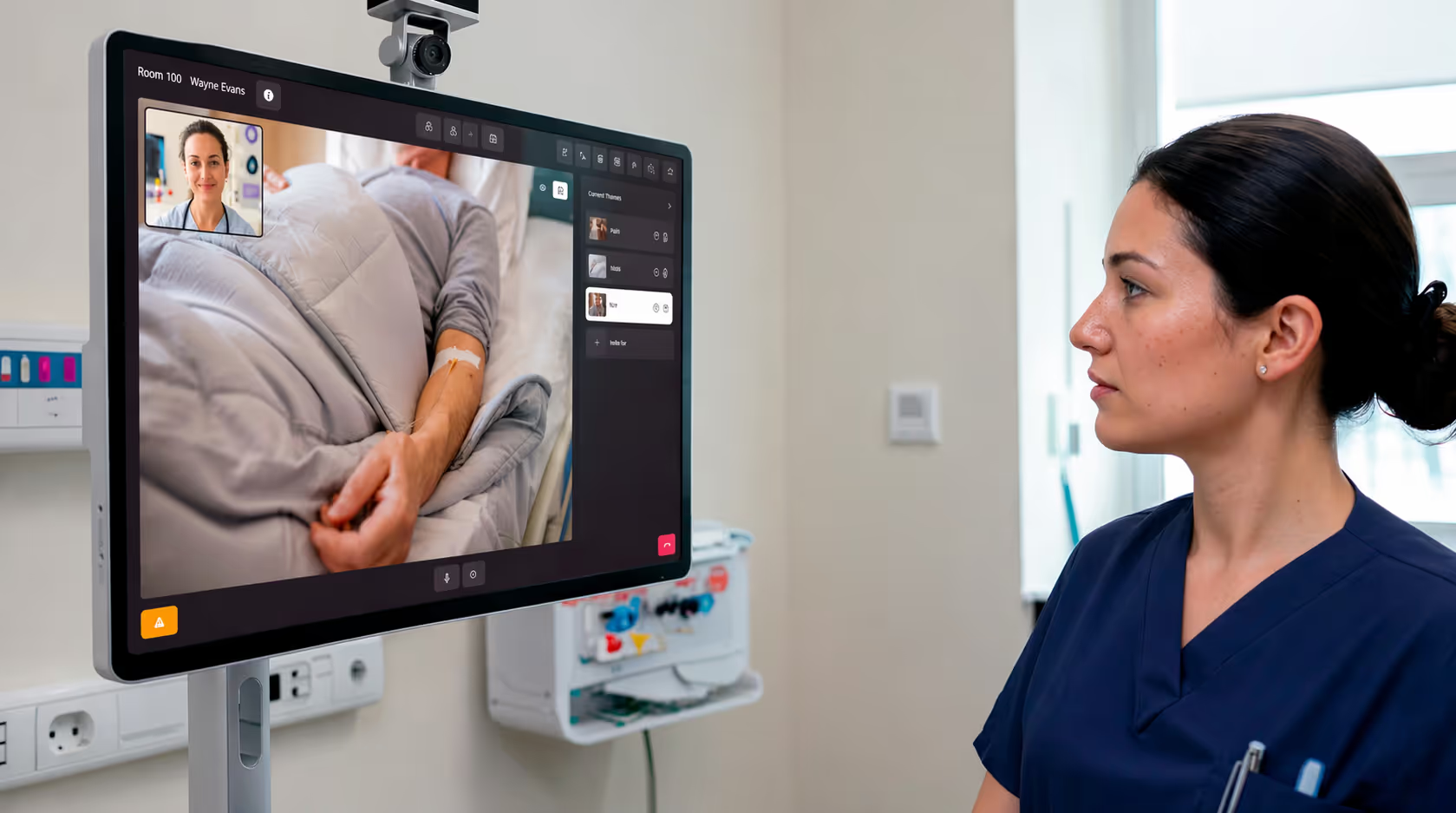
Vitalchat is hardware-flexible by design: the platform runs on the equipment already in the room where it can, and on modest additions where it cannot. Existing televisions serve as the patient-facing display, no wiring change is required in most retrofits, and the software layer expands from virtual nursing into sitter and tele-ICU use cases without a second deployment. A University Hospitals program built this way returned a reported $10M within six months.
Deploy on what you have
If three or more of these five signs describe your organization, the readiness question is already answered. What remains is choosing one unit, one workflow, and ninety days. Schedule a Demo and our clinical team will walk your units and tell you what is usable as-is.
FAQ
How many of the five signs justify starting a program?
One is enough to pilot on a single unit; three or more usually means the cost of waiting is higher than the cost of starting. The signs are cumulative because they share a root cause, licensed nursing time consumed by work that does not require presence at the bedside.
Does virtual nursing reduce bedside staffing?
No, and programs presented that way tend to lose the unit's trust in the first month. The virtual nurse absorbs documentation, admission and discharge workflows, which returns hours to the nurses already on the floor. Staffing plans change only where a system chooses to redeploy those recovered hours.
What has to be in place before we can start?
A camera and speaker unit with a privacy shutter in the pilot rooms, network capacity for concurrent sessions, a written scope of practice for the virtual nurse, and a named owner for each escalation type. Hardware is rarely the blocker; the written scope usually is.
How long before the program shows a result?
Discharge timing moves within about six weeks on a single unit. Documentation time takes closer to twelve, because it depends on nurses trusting that the charting is genuinely done. Systems that measure a two-week baseline before go-live can show both.
What if we already tried a pilot and it stalled?
Restart it as a scope exercise rather than a technology exercise. In most stalled programs the cameras still work; what was never finished is the one-page division of workflows and the overnight escalation protocol.
Is the video feed recorded?
No. Sessions are initiated by a nurse, announced in the room, and not retained. Patients can decline a virtual visit the way they can decline any other non-emergent interaction, and the shutter is visible from the bed.