
A software-led virtual care platform runs on the cameras, screens, and network infrastructure a hospital has installed. The software, not a proprietary device, determines what the system does and how it scales.
For IT and operations teams evaluating a program, that distinction often decides whether a rollout starts in weeks or waits on a capital budget approval.
Key Takeaways
- A software-led virtual care platform runs on the cameras, screens, and network infrastructure a hospital already has installed.
- Open platforms let health systems add best-in-breed tools over time, and closed, hardware-first systems tie every new capability to one vendor's roadmap and pricing.
- Vitalchat runs on the hardware hospitals already have, from PTZ cameras to the entertainment systems in patient rooms, and supports a range of certified clinical peripherals.
- University Hospitals scaled Vitalchat-powered virtual nursing programs on infrastructure already in place.
Do I Need Special Hardware for Virtual Nursing?
No single piece of hardware defines virtual nursing. A virtual nursing program can run on cameras, screens, and network connections many hospitals already have installed, paired with software that adds the workflows a virtual nurse needs including admission and discharge support, rounding, and family communication.
For IT and operations teams sizing up a program, the real question is how well the software layer adapts to the rooms already in place.
That question matters more than it might seem during evaluation, when program cost is often measured room by room.
A platform built to work with equipment already installed keeps a new virtual care program inside that existing footprint.
What Is a Software-Led Virtual Care Platform?
A software-led virtual care platform keeps its intelligence, workflows, and integrations in software that runs on standard clinical hardware. Cameras, screens, and network connections make up the input and output layer, and new capabilities ship as software updates.
That structure is what separates an open, software-led platform from a closed, hardware-first system built around one vendor's proprietary devices.
| Closed, hardware-first system | Open, software-led platform | |
|---|---|---|
| Hardware | Requires proprietary devices in every room | Works with cameras, screens, and network gear already installed |
| New capabilities | Often require a new device or room retrofit | Ships as a software update |
| Vendor relationship | Locked to one vendor's roadmap and pricing | Integrates best-in-breed tools as needs evolve |
| IT lift | Full room build-out before go-live | Software deployment on infrastructure already in place |
Vitalchat is built on the open model, delivered through a software-led foundation that starts with real-time audio and video, then layers in the workflows care teams need through one visual interface.
Can It Use Our Existing Cameras and TVs?
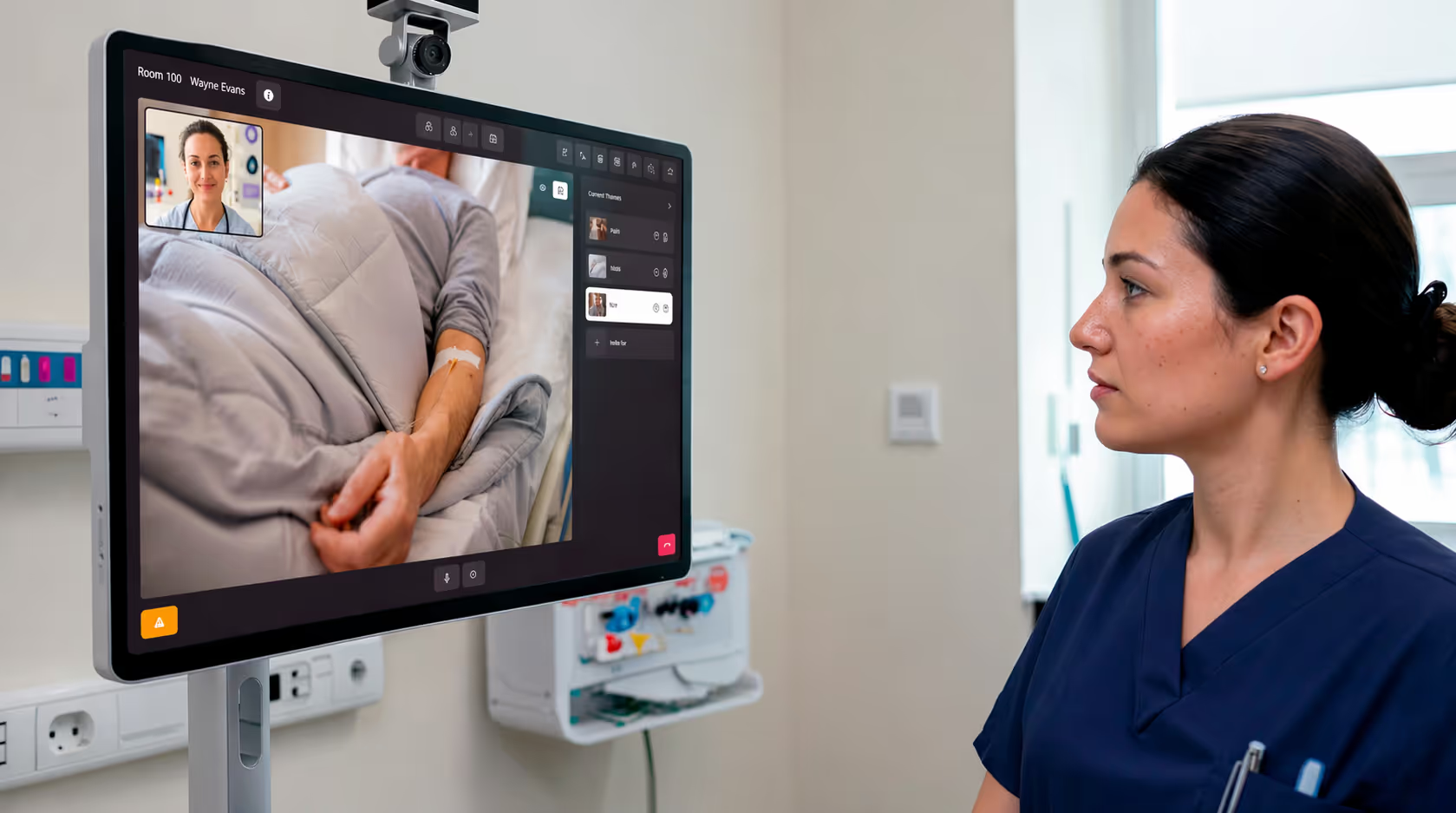
In most cases, yes. Vitalchat supports a range of certified clinical peripherals, including PTZ cameras, and integrates with hospital entertainment systems for a unified patient room experience.
An implementation team can confirm compatibility for a specific hospital's equipment during the technical assessment that precedes a rollout, so IT teams can plan a program around what's already in place.
How Vitalchat Builds Hardware-Flexible Virtual Care
Vitalchat's brand promise, software-led, hardware-flexible, clinically-driven care on your terms, describes an architecture choice as much as a market position.
University Hospitals
University Hospitals expanded its Vitalchat program hospital-wide and reported stronger support for admissions, discharges, pain assessments, and fall prevention.
University Hospitals added virtual nursing as a module on infrastructure already in place, the same evaluation lens covered in 10 questions to ask before you sign a virtual nursing vendor and what virtual nursing is.
Read the full University Hospitals virtual nursing program announcement for the full results.
See It in Your Environment
Schedule a Demo to see how a software-led, hardware-flexible virtual care platform fits your hospital's current environment.
FAQ
Do I need special hardware for virtual nursing?
No. Virtual nursing software runs on cameras, screens, and network infrastructure many hospitals already have in patient rooms. A software-led platform adds workflows such as admission support, rounding, and discharge teaching on top of that existing equipment, so evaluation centers on the software's capabilities and how well they fit the rooms a hospital already has.
What is a software-led virtual care platform?
A software-led virtual care platform keeps its intelligence, workflows, and integrations in software that runs on standard clinical hardware. Cameras and screens serve as the input and output layer, while capabilities expand through software updates, giving health systems room to grow without a new device for every new use case.
Can it use our existing cameras and TVs?
In most cases, yes. Vitalchat supports a range of certified clinical peripherals, including PTZ cameras, and integrates with hospital entertainment systems for a unified patient room experience. An implementation team confirms specific compatibility during the technical assessment ahead of a rollout.
Sources
- Average Hospital IT Expenses & Budget Benchmarks, Definitive Healthcare
- ONC's Cures Act Final Rule, Office of the National Coordinator for Health Information Technology
- A New Standard for Virtual Nursing at Scale, Vitalchat Case Study: University Hospitals