Virtual nursing is a care delivery model that uses live video, two-way audio, and remote monitoring so a licensed nurse working outside the patient's room can support the nurse at the bedside. The virtual nurse handles tasks including admissions, discharge documentation, second verification of medications, and call light triage, freeing the bedside nurse to focus on hands-on care.
For a chief nursing officer evaluating care model redesign, the model matters more than the technology: virtual nursing works best when hospitals define, up front, which tasks move from a bedside nurse to a virtual nurse.
Key Takeaways
- Virtual nursing pairs a bedside nurse with a remote RN who takes on admissions, discharge paperwork, second-verification checks, call light triage, and other tasks that do not require a physical presence in the room.
- The American Nurses Association classifies virtual nursing as a care delivery modality that spans nursing specialties, not a specialty of its own, and its 2025 principles position the virtual nurse as additional support for bedside staffing.
- Hospital leader confidence is climbing. In a 2024 survey of hospital and IT leaders, 74% said virtual nursing is, or will become, integral to acute inpatient care, up from 66% the year before.
- Results depend heavily on implementation. A December 2025 study of 880 bedside nurses published in JAMA Network Open found that 57% reported no reduction in workload from virtual nursing, a reminder that role design shapes outcomes as much as the software itself.
- Virtual nursing is a subset of telehealth, not a synonym for it. Telehealth is the broad umbrella for remote care delivery, while virtual nursing specifically applies the nursing process, and a nurse's license and judgment, inside a hospital unit.
A virtual nurse is a licensed registered nurse who cares for patients from a location apart from the bedside. The role is nursing work that is simply performed through a screen instead of at the rail of the bed.
What Does a Virtual Nurse Actually Do on a Shift?
Elizabeth Glidewell, MSN, RN, CCRN, a nurse with nearly 20 years of bedside and virtual care experience, describes the value this way: “There are a lot of things that the registered nurse who’s on the other side of the camera can do for the bedside nurse that would take some of that burden off of the bedside nurse.”
On a typical shift, a virtual nurse might do the following.
- Complete patient admissions and discharge education, including medication review and home care instructions.
- Provide the required second verification for high-alert medications or blood products.
- Answer call lights first, triage the request, and loop in bedside staff or a patient care technician as needed.
- Monitor patients for signs of clinical deterioration alongside bedside staff.
- Handle compliance documentation tied to safety bundles, such as fall prevention or infection prevention checklists.
- Mentor newer nurses through complex situations in real time.
It is so important for the bedside team to be a part of the plan. Coming in from the outside and saying, “We’re here, we’re the experts,” it didn’t work.
Defining which nurse owns which task, and communicating that clearly to both teams, is what separates programs that stick from ones that create friction.
How Does Virtual Nursing Work Inside a Hospital?
Inpatient virtual care typically runs through cameras and two-way audio devices installed in patient rooms, connected to a dedicated command center or to nurses working remotely from home or another unit. When a bedside nurse or patient needs support, they connect with the virtual nurse through the in-room device, and the virtual nurse can see, hear, and speak with everyone in the room in real time.
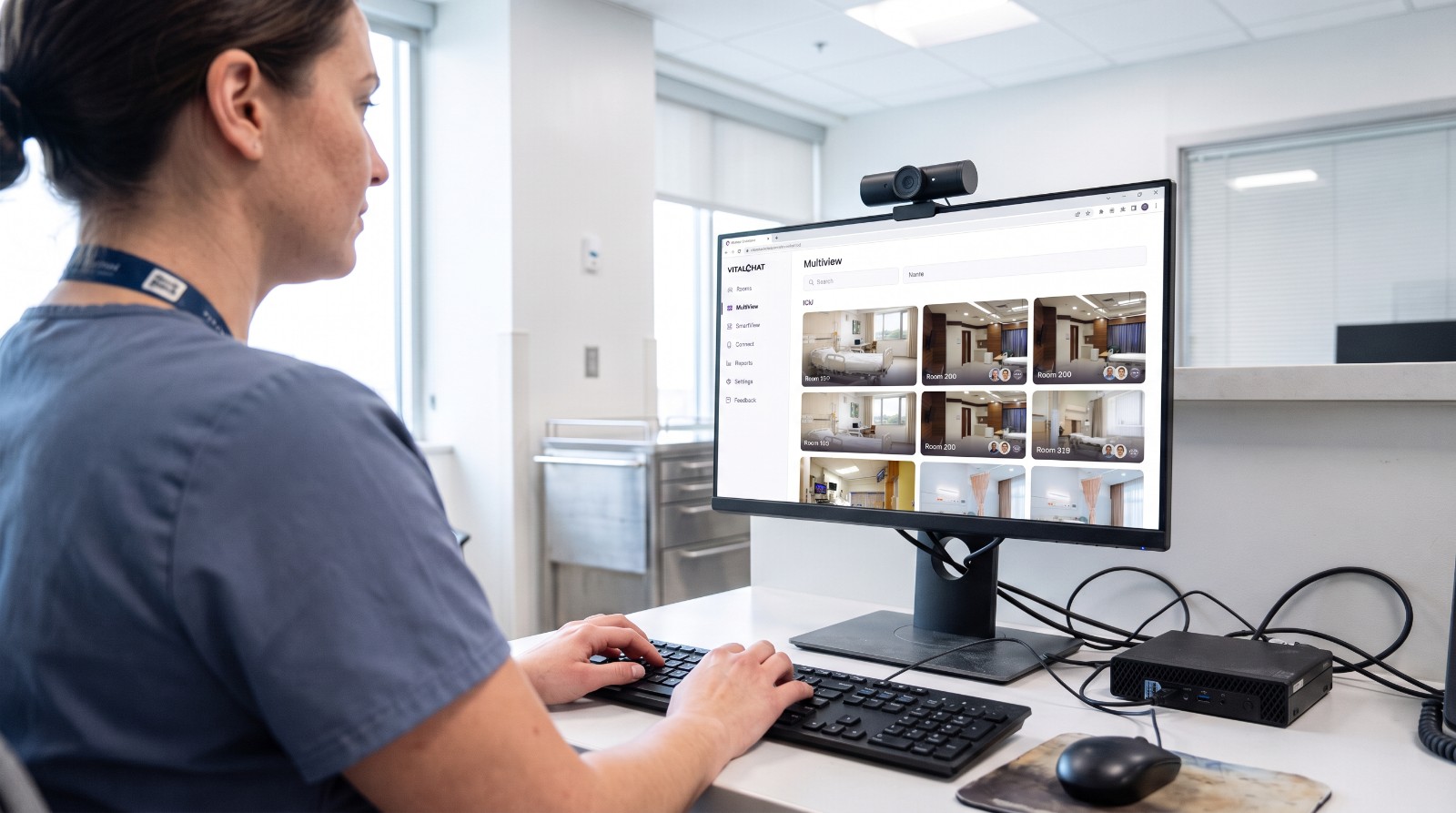
Two Staffing Models, Often Blended
How Is Virtual Nursing Different From Telehealth?
Telehealth is the umbrella term for any healthcare delivered remotely through technology, spanning physician video visits, remote patient monitoring, and behavioral health sessions. Virtual nursing sits inside that umbrella as a specific application: a licensed nurse applying the nursing process, inside a hospital or health system, to support inpatient care.
| Telehealth (general) | Virtual nursing | |
|---|---|---|
| Who delivers care | Physicians, nurse practitioners, therapists, and other clinicians, as well as nurses | Licensed registered nurses |
| Typical setting | Outpatient visits, remote monitoring, behavioral health, and specialty consults | Inpatient hospital units, working alongside a bedside team |
| Patient relationship | Often episodic or scheduled | Continuous, in partnership with the assigned bedside nurse |
| Core purpose | Extend access to a clinician regardless of location | Extend nursing capacity and support safe staffing on a unit |
The American Nurses Association’s April 2025 “Principles of Virtual Nursing” defines virtual nursing as “leveraging remote technology and tools to provide safe and quality patient care through the nursing process by emphasizing communication, compassion and collaboration throughout the continuum of care,” and it positions virtual nursing within the broader telehealth landscape as a nursing-specific application of it.
Why Are Hospitals Adopting Virtual Nursing Now?
The short answer is staffing math that no longer works. Three trends are pushing hospital leaders to redesign care models around virtual nursing.
Turnover Is Expensive and Still Rising
The average cost to replace a single staff RN reached $60,090 in 2025, and the typical hospital now loses between $4.2 million and $6.2 million a year to RN turnover, with the national RN turnover rate climbing to 17.6%, according to the 2026 NSI National Health Care Retention & RN Staffing Report.
The Pipeline Cannot Keep Pace With Demand
U.S. nursing schools turned away a record 93,176 qualified applicants in 2025 due to faculty and clinical placement shortages, according to the American Association of Colleges of Nursing’s 2025–2026 enrollment survey, even as interest in nursing careers keeps growing.
Experienced Nurses Are Approaching Retirement
Workforce researchers have projected that roughly 1 million registered nurses would reach retirement age by 2030, a figure the profession’s own workforce analysis still cites as a planning benchmark. Virtual roles have become a documented way to retain that experience. Elizabeth Glidewell said hospitals have kept nurses who had already given notice by moving them into virtual care: “They could do this for a couple more years. If you took the physical part of it off of me, I could do this for a couple more years. And people are staying.”
Hospital leaders are responding
In a 2024 survey of hospital and health system leaders, 74% said virtual nursing is, or will become, integral to acute inpatient care delivery, up from 66% the year before, and 46% reported they were already piloting or had implemented a program.
Is Virtual Nursing Worth It?
Virtual nursing can produce measurable results, and the evidence is clear that program design shapes those results as much as the technology itself. Hospitals that treat virtual nursing as a staffing strategy, with defined roles and a bedside team involved in the design, see stronger outcomes than hospitals that add a camera to an unchanged workflow.
The proof point side of the ledger is real. University Hospitals, a Cleveland-based health system, expanded its virtual nursing program to a whole-hospital model after Phase 1 results showed higher patient experience and caregiver engagement scores than comparable units, along with more efficient support for admissions, discharges, pain assessments, and fall prevention workflows, according to a Sept. 17, 2025, announcement of the expansion.
By reimagining how nurses deliver care, UH is proving it’s possible to simultaneously ease workforce strain, improve safety and elevate the patient experience.
“The success of Phase 1 gave us the confidence to expand to a whole-hospital launch,” said Brian Nelson, the program’s lead.
The Caution Side Is Just as Real
A December 2025 study of 880 bedside nurses published in JAMA Network Open found that 57% reported virtual nursing did not reduce their workload, and 10% said it made their workload worse, while just 11% described the improvement in care quality as substantial.
The study’s authors, from the University of Pennsylvania School of Nursing’s Center for Health Outcomes and Policy Research, concluded that success hinges on sufficient bedside staffing, well-defined roles, and virtual nurses working as additional capacity alongside a fully staffed bedside team.
The most important thing you can do to use your data well is to make sure that you have good, solid, thorough pre-implementation data, so that you know what you’re comparing your results to.
Hospitals that skip this step often cannot demonstrate impact later, even when the program is working.
What Should a CNO Look for in a Virtual Nursing Platform?
Not every virtual nursing platform is built the same way, and the differences show up fastest during implementation. When evaluating virtual nursing solutions, hospital leaders in the interviews behind this guide pointed to the same handful of criteria.
Software-led, hardware-flexible, clinically driven
Vitalchat starts with real-time audio and video, then layers in the workflows and capabilities care teams need through one visual interface, built to work with hospitals’ existing hardware environments and protect the technology investment already in place. That gives health systems room to start with one use case and expand into virtual sitting, specialist consults, or family connection from the same foundation, without adding headcount to maintain a separate system for each.
FAQ
What is virtual nursing?
Virtual nursing is a care delivery model in which a licensed registered nurse, working from a location apart from the patient's bedside, uses live video and audio to support patient care alongside the nurse physically in the room. It typically covers tasks such as admissions, discharge, medication verification, and patient monitoring, and it is designed to expand nursing capacity while keeping the bedside team fully staffed.
What is a virtual nurse?
A virtual nurse is a licensed registered nurse who delivers nursing care remotely through video and audio technology instead of at the bedside. Virtual nurses perform many of the same duties as bedside nurses, including admissions, discharge education, second verification of medications, and patient monitoring, and they work as part of the same care team as bedside staff.
Is virtual nursing worth it?
It depends on implementation. Hospitals with clearly defined roles, adequate bedside staffing, and workflows co-designed with floor nurses report gains in patient safety, patient experience, and nurse retention. A December 2025 study found more than half of bedside nurses saw no workload relief, underscoring that program design shapes the return on virtual nursing as much as the technology does.
How is virtual nursing different from telehealth?
Telehealth is the broad category for any healthcare delivered remotely through technology, including physician visits and remote monitoring. Virtual nursing is a specific application of telehealth in which a licensed nurse applies the nursing process, inside a hospital unit, in continuous partnership with the assigned bedside nurse.
Sources
- American Nurses Association. “Principles of Virtual Nursing.” April 23, 2025. nursingworld.org
- Healthcare IT News. “74% of Hospital Leaders Say Virtual Nursing Will Become Integral to Acute Care.” Citing the 2024 Virtual Care Insight Survey conducted by Joslin Insight in collaboration with the American Organization for Nursing Leadership. healthcareitnews.com
- Becker’s Hospital Review. “The Cost of Nurse Turnover in 10 Points.” 2026, citing the 2026 NSI National Health Care Retention & RN Staffing Report. beckershospitalreview.com
- Nurse.org. “Record 93,000 Nursing Applications Turned Away in 2025, Despite Rising Enrollment.” Citing the American Association of Colleges of Nursing’s 2025–2026 Enrollment and Graduations survey. nurse.org
- University of Pennsylvania School of Nursing. “Penn Nursing Study: Virtual Nursing Programs in Hospitals Fall Short of Expectations.” December 2025, citing findings published in JAMA Network Open. nursing.upenn.edu
- PR Newswire. “University Hospitals Collaborates With Vitalchat to Set National Standard in Virtual Nursing.” Sept. 17, 2025. prnewswire.com