A hospital fall prevention program is a coordinated system of risk screening, matched interventions, and observation that keeps each patient at the level of watchfulness their risk calls for. The strongest programs manage falls, wandering, and elopement together and reserve in-person 1:1 sitters for patients who need hands-on care. Continuous virtual observation covers the wide middle, where one trained observer can support many rooms.
Key Takeaways
- A fall prevention program works best as a tiered system: universal precautions for every patient, targeted interventions for moderate risk, continuous observation for high risk, and in-person 1:1 care for the few who need it.
- Between 700,000 and 1 million people fall in U.S. hospitals each year, and a serious fall with injury averages $14,056 per patient, according to the American Hospital Association, citing published research.
- Since Oct. 1, 2008, Medicare has not paid hospitals extra for falls and trauma that were not present on admission, under the CMS hospital-acquired conditions policy.
- Elopement risk is highest among patients with cognitive impairment, psychosis, or a history of leaving, and the same observation program that prevents falls can catch an exit attempt early.
What Is a Fall Prevention Program in a Hospital?
A fall prevention program is the set of policies, assessments, interventions, and metrics a hospital uses to identify patients at risk of falling and keep them safe throughout their stay. It runs across every unit and shift, and it holds up best when it is built as a system with clear ownership.
The Six Building Blocks
Most effective programs share six building blocks.
The stakes are high for patients and for hospitals. Between 30% and 35% of patients who fall in the hospital are injured, and an injury can add about 6.3 days to a stay, according to the AHA's fall prevention guide. Falls and trauma also sit on the CMS list of hospital-acquired conditions, which means the cost of that longer stay largely falls on the hospital.
For a closer look at how continuous observation fits inside this system, see our earlier post, how virtual observation helps prevent falls.
Why Can't 1:1 Sitters Scale?
A 1:1 sitter watches one patient per shift, so sitter cost and staffing grow in a straight line with every high-risk patient, and demand often peaks when staff are hardest to find.
Sitters remain essential for some patients. The challenge is that many hospitals assign them to every high-risk patient by default, which drains staffing that bedside teams need elsewhere.
Bed alarms signal movement, not prevention
In a cluster randomized trial published in the Annals of Internal Medicine, a standardized bed alarm intervention did not reduce falls among older hospitalized patients compared with usual care. An alarm signals that a patient is already moving. It does not give anyone a chance to talk with the patient first.
Continuous virtual observation adds that opportunity. A trained observer watches several rooms through cameras, speaks to a patient who starts to get up, and calls the bedside team when someone needs to be in the room. The published results are encouraging.
How Should Hospitals Stratify Patients by Risk?
Risk stratification sorts patients into observation tiers based on fall risk, wandering or elopement risk, behavioral risk, and whether they can be verbally redirected. Each tier gets a different level of watchfulness, so sitters go to the patients who need hands-on care and virtual observation covers the larger group who can be safely redirected by voice.
| Tier | Who it covers | Observation approach |
|---|---|---|
| 1. Universal | All inpatients | Purposeful rounding (pain, potty, position, possessions), safe environment, patient and family education |
| 2. Moderate | Patients with a positive fall risk screen and no cognitive or behavioral concerns | Tier 1 plus scheduled toileting, medication review, mobility plan, and alarms as a backup signal |
| 3. High, redirectable | Patients with high fall risk, delirium, dementia, wandering, or elopement risk who respond to verbal cues | Continuous virtual observation, with a bedside responder named for every shift |
| 4. Hands-on | Patients at high risk for suicide, patients who cannot be redirected by voice, and patients who need physical intervention | In-person 1:1 observation, with video used only as a complement where policy allows |
Two practices keep this system honest
- Reassess at least once per shift and after any change in condition, so patients step down to a lower tier as they improve.
- Document why each patient is in each tier, which helps risk and quality teams review decisions after an event.
What Does Elopement Risk Mean in a Hospital?
Elopement risk is the likelihood that a patient who is not safe to leave will exit the unit or facility without staff knowledge. The VA National Center for Patient Safety separates two related behaviors.
The Elopement Risk Assessment
An elopement risk assessment typically asks whether the patient:
- Lacks the cognitive ability to make relevant decisions
- Has a history of escape, elopement, or wandering
- Has physical or mental impairments that increase the risk of harm to self or others
- Is under a legal hold, commitment, or court-appointed guardianship
- Is a danger to self or others
One "yes" is enough
A "yes" to any one of these questions indicates elopement risk, according to the VA assessment questions published by AHRQ's Patient Safety Network. The National Quality Forum lists patient death or serious injury associated with elopement among its serious reportable events, so this is a core concern for risk teams.
Because elopement and falls often share the same underlying causes, such as delirium, dementia, and confusion at night, a single observation program can watch for both. The observer who sees a patient sit up at the bedside edge can also see a patient walking toward the door.
What Metrics Should a Fall Prevention Program Track?
A fall prevention program should track outcomes, resource use, and observation performance against a baseline collected before any change goes live.
The most important thing you can do to use your data well is to make sure you have pre-implementation data.
 Elizabeth Glidewell, MSN, RN, CCRN, CAVRNDirector of Nursing, Clinical Innovation and Implementation, Vitalchat
Core Metrics to Track
- Falls and falls with injury per 1,000 patient days
- Elopement and wandering events, including near misses
- 1:1 sitter hours and cost per unit
- Restraint orders and restraint hours
- Patients per observer and observation coverage by shift
- Time from verbal redirection to bedside response
- Patient and family experience scores on observed units
For guidance on growing a program unit by unit once the baseline is set, see scaling virtual care from pilot to program.
How Vitalchat Supports a Fall Prevention Program Across Risk Types
As Dr. Alan Pitt describes it, Vitalchat gives health systems "eyes and ears for healthcare," enabling clinicians, patients, and families to come together for better care at a lower cost. For fall and elopement prevention, that means one software-led, hardware-flexible platform where trained observers can watch for falls, wandering, and exit attempts across many rooms, in the same visual interface remote nurses use for admissions, discharges, and patient education.
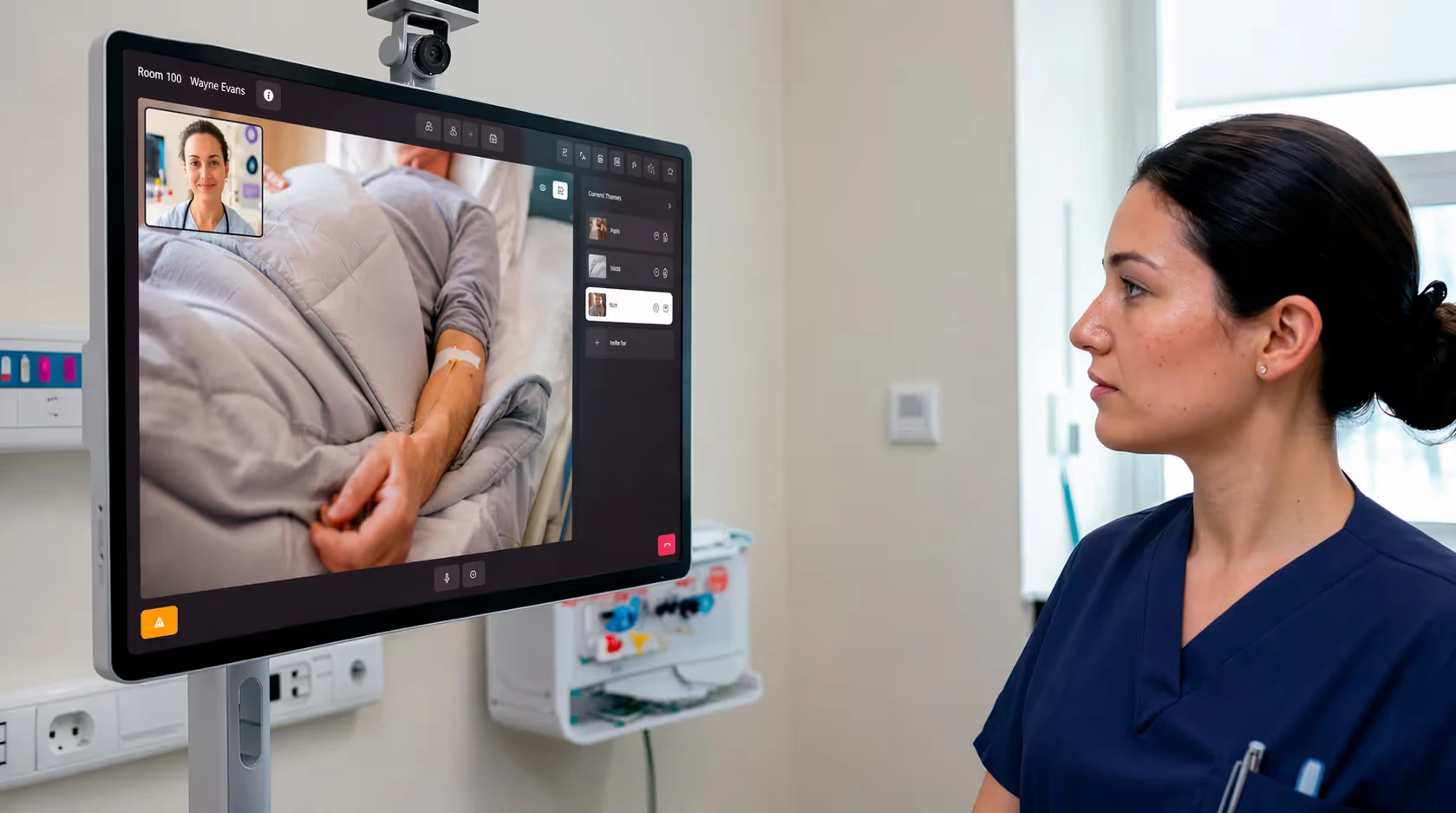
Every observation program depends on people. Observers see and speak with patients in real time, and they escalate to the bedside team when a patient needs hands in the room. Clinicians decide each patient's tier, and the platform helps them act on that decision across every unit that uses it. Because Vitalchat works with the cameras, screens, and EHR systems a hospital already has, adding observation to a new unit is a configuration step with no new hardware program required.
University Hospitals
Phase 1 of its Vitalchat-powered program included more efficient fall prevention support alongside admissions, discharges, and pain assessments, along with higher patient experience scores than comparable units.
Read the University Hospitals case study to see how the program grew.
Related reading: Virtual Sitter vs. Virtual Nurse vs. Telehealth: What's the Difference for Hospitals? | The 5 Virtual Nursing Use Cases, and Which One to Start With
See it across falls, wandering, and elopement
Schedule a Demo to see how Vitalchat supports a fall prevention program across falls, wandering, and elopement risk on the hardware you already have.
FAQ
What are the 5 P's of falls prevention?
The 5 P's build on the four P's of purposeful rounding: pain, potty, position, and possessions. The fifth P varies by hospital. Common versions include peripherals, such as IV lines, tubing, and drains that can tangle or pull, and a check that the patient's personal plan for safety is in place before staff leave the room.
What is the best falls prevention method in hospital?
No single method works alone. The best results come from a multifactorial fall prevention program that pairs risk assessment with matched interventions and tiered observation. Bed alarms alone did not reduce falls in a randomized trial, while continuous virtual observation has been linked to fewer falls and fewer 1:1 sitter hours.
Does Medicare pay for fall prevention?
Medicare Part B covers fall risk screening as part of the Annual Wellness Visit. For inpatients, Medicare has not paid hospitals extra since Oct. 1, 2008, for falls and trauma not present on admission. Hospitals generally fund inpatient fall prevention programs, including sitters and observation, as an operating cost.
What are the four P's of fall prevention?
The four P's are pain, potty, position, and possessions. During purposeful rounding, staff ask about pain, offer toileting help, reposition the patient for comfort, and place essential items such as the call light, phone, water, and glasses within easy reach. Each one addresses a common reason patients get up alone.
What does elopement risk mean in a hospital?
Elopement risk is the likelihood that a patient who is not safe to leave will exit the unit or facility without staff knowledge. Elopement involves intent to leave. Wandering, a related risk, happens when a patient strays beyond staff view without intending to leave, often because of dementia or delirium.
Which patient is at highest risk for elopement?
Patients at highest risk for elopement typically have cognitive impairment from dementia or delirium, a history of elopement or wandering, psychosis, or a legal hold. Research on psychiatric patients also links younger age and medication nonadherence to higher elopement risk. Any one of these factors should prompt an elopement risk assessment.
Sources
- Preventing Patient Falls: A Systematic Approach from the Joint Commission Center for Transforming Healthcare Project, American Hospital Association (citing Currie 2008; Galbraith et al. 2011; Haines et al. 2013; Wong et al. 2011)
- Hospital-Acquired Conditions, Centers for Medicare & Medicaid Services
- Annual Wellness Visit, Centers for Medicare & Medicaid Services
- Shorr RI, Chandler AM, Mion LC, et al. Effects of an Intervention to Increase Bed Alarm Use to Prevent Falls in Hospitalized Patients: A Cluster Randomized Trial. Annals of Internal Medicine, 2012 (summary via AHRQ PSNet)
- Study Demonstrates Continuous Video Monitoring Reduces Patient Falls, Conserves Resources in Long-Term Acute Care Hospital Setting, Gaylord Specialty Healthcare (Nov. 20, 2025), reporting a study in the American Journal of Nursing
- How Virtual Sitter Services Saved St. Luke's $1.5M in 2023, Healthcare IT News (Jan. 29, 2024)
- Elopement, AHRQ Patient Safety Network WebM&M (citing VA National Center for Patient Safety and Gerardi, 2007)
- Elias G. Risk Factors and Legal Implications of Psychiatric Patient Elopement From Hospital Settings, American Academy of Forensic Sciences (2016)
- Ligature and/or Suicide Risk Reduction: Video Monitoring of Patients at High Risk for Suicide, The Joint Commission Standards FAQ
- 42 CFR 482.13, Condition of Participation: Patient's Rights (restraint or seclusion), Electronic Code of Federal Regulations
- Hourly Rounding, NRC Health