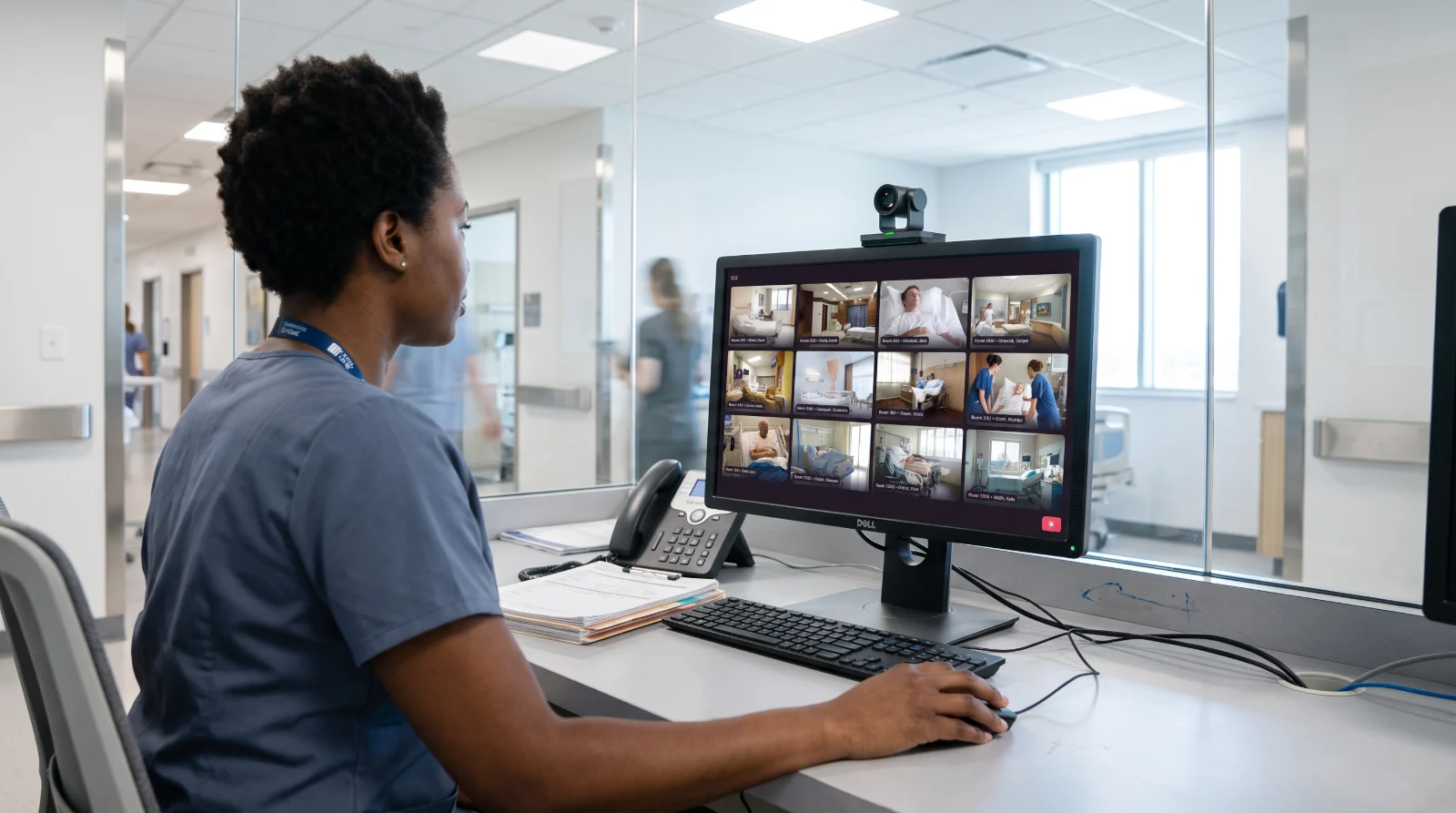
A virtual sitter is a trained observer who watches a patient for fall risk through an in-room camera and two-way audio from a remote monitoring station. One virtual sitter can cover many rooms at once, speaking directly to a patient the moment they try to get up unassisted.
On a unit that cannot staff a one-to-one sitter for every at-risk patient, that changes what fall coverage actually looks like.
Key Takeaways
- A virtual sitter monitors patients for fall risk from a remote station using camera and audio technology, and one person can cover far more rooms than a single in-person sitter could watch alone.
- Hospitals see somewhere between 700,000 and 1,000,000 inpatient falls every year, according to the Agency for Healthcare Research and Quality.
- Virtual observation adds a layer of coverage alongside the bedside team; it gives nurses another set of eyes on rooms they cannot physically be in at every moment.
- Vitalchat’s SmartView technology flags risk behavior, such as a patient swinging their legs over the bed rail, and surfaces it to the person watching the screen so they can act on it.
What Is a Virtual Hospital Sitter?
A virtual hospital sitter is a person, often a certified nursing assistant or trained monitoring technician, who watches one or more patients through an in-room camera and speaks to them over two-way audio from a station away from the bedside. Where a traditional one-to-one sitter sits inside a single patient’s room for a full shift, a virtual sitter works from a monitoring hub and can be assigned a group of rooms at the same time.
This is sometimes called virtual patient observation or e-sitting. The virtual sitter watches for unsafe movement, redirects verbally, and alerts the bedside team when a patient needs hands-on assistance.
How Do Virtual Sitters Prevent Falls?
Virtual sitters prevent falls mainly through continuous observation and fast verbal redirection, catching an unsafe movement in the seconds before it becomes a fall, not after. When a patient starts to swing their legs over the bed rail or reaches for a walker without help, the virtual sitter can speak into the room immediately: “Mrs. Johnson, please wait, I’m calling someone to help you up.” That single interruption is often enough to prevent a fall.
The Staffing Math Is Part of the Story
A bedside nurse managing several patients cannot watch every room at once. A virtual sitter’s job is to be the person who can.
Having a strong nurse leader with access to the right tools to determine when and if it is necessary to move or reallocate resources in the moment is key to providing safe patient care.
 Elizabeth Glidewell, MSN, RN, CCRNDirector, Nursing, Clinical Innovation and Implementation, Vitalchat
From Reactive to Proactive
That shift also moves fall prevention from reactive to proactive.
Monitoring for deterioration is something where you’re starting to be more proactive, rather than waiting for somebody to decline before you act.
 Marcia MurphyChief Nursing Officer, Vitalchat
The same logic applies to falls: the goal is to see the risk building and step in before an incident report gets written, not after.
How Much Does a TeleSitter Cost?
There is no single published price for a TeleSitter or virtual observation program. Cost depends on how many rooms are being monitored, what camera and audio hardware is already installed, and the staffing ratio a hospital chooses to run.
What is easier to price is the status quo it’s replacing. The average U.S. hospital sitter earns about $19 an hour, or roughly $39,700 a year, according to Salary.com, and a one-to-one program requires a dedicated person for every patient who needs continuous watching, every shift, every day.
The exact cost of building that out for a specific hospital, room count, and camera setup is best worked through with a vendor directly.
How Vitalchat Approaches Fall Prevention
Vitalchat uses real-time audio and video together with the workflows and signals a care team needs into one interface. For fall prevention specifically, that shows up in two features.
MultiView
Brings camera feeds from several rooms onto one screen, giving a single virtual observer visibility across multiple rooms at once.
SmartView
Trained to flag certain behavior, such as a patient attempting to get out of bed unassisted, and surface that flag to the person watching, so they know where to look first.
The emphasis is on support, not replacement.
The AI can improve the quality and accuracy of our physical assessments and, most importantly, can supply real-time information. It can tell me very subtle changes.
Elizabeth Glidewell, MSN, RN, CCRNDirector, Nursing, Clinical Innovation and Implementation, VitalchatThe technology’s job is to help the person on watch see the risk sooner. The judgment and the response still belong to the clinical team.
University Hospitals
Running a virtual nursing program with Vitalchat since 2025, University Hospitals reported higher patient experience and caregiver engagement scores than comparable units during its first phase, along with more efficient support for admissions, discharges, pain assessments, and falls prevention workflows, including an FDA-supported trial evaluating AI to detect fall risk.
See virtual observation on your own units
Walk through room coverage, escalation and the staffing math with our clinical team.
FAQ
What is a virtual hospital sitter?
A virtual hospital sitter, or virtual patient observer, monitors patients for fall risk and other safety concerns through an in-room camera and two-way audio, working from a remote station instead of sitting inside the room. One virtual sitter can typically watch several rooms at once.
How much does a TeleSitter cost?
There is no fixed published cost. Pricing depends on the number of rooms monitored, existing camera and audio hardware, and the staffing ratio a hospital runs. It typically compares against the cost of staffing a dedicated one-to-one sitter, averaging about $19 an hour, for every at-risk patient around the clock.
How do virtual sitters prevent falls?
Virtual sitters prevent falls by watching continuously and speaking directly into the room the moment a patient attempts an unsafe movement, such as getting up unassisted. That verbal redirection, backed by technology that flags risk behavior for the observer, catches the risk before it becomes an incident.
What is virtual patient observation?
Virtual patient observation is the general term for monitoring a patient’s safety remotely, using camera and audio technology from a station away from the bedside. Virtual sitting for fall risk is one common use case; the same setup also supports continuous observation for other safety concerns during a hospital stay.
Sources
- Agency for Healthcare Research and Quality. Inpatient fall volume in U.S. hospitals. ahrq.gov
- Salary.com. Average hospital sitter hourly and annual pay. salary.com
- University Hospitals collaborates with Vitalchat — program results, 2025. vitalchat.com