I started my career in radiology, but I migrated to telemedicine early, when I realized that the same principles behind teleradiology could be applied much more broadly across medicine.
Since then, I have watched telemedicine evolve through distinct eras. It began with cart-based systems and limited architectures, often little more than a screen wheeled from room to room. It expanded into a collection of niche business opportunities. Today, it is becoming something much more consequential: a strategy for extending expertise and enabling care across the entire continuum.
Over the years, I have come to believe there is another force driving that evolution that we do not talk about enough. Anxiety. Anxiety for the patient. Anxiety for the family. And, perhaps most overlooked, anxiety for the clinician who suddenly finds themselves facing a situation they do not encounter often enough to manage with complete confidence.
Key Takeaways
- The barrier in a rare clinical event is rarely training. It is repetition, because decisions never become reflexive when the case appears once a year.
- Every clinician has a scenario they quietly hope does not walk through the door during their shift. Medicine holds more knowledge than any one person can be fluent in.
- Telemedicine's underrated function is delivering expertise to the clinician at the exact moment uncertainty enters the room.
- Clinical anxiety is not harmless: it drives inappropriate treatment, unnecessary transfers, and escalation of care that was avoidable.
- Access to a clinician is only one form of access. Access to expertise is the other, and it is the one we measure least.
The Cases We Quietly Dread
I first understood the power of that anxiety while working in imaging centers. I was trained to manage patients having contrast reactions. On paper, I knew exactly what to do. The problem was that serious reactions were rare, something I might encounter roughly once a year.
So when one actually happened, I was not calm and rehearsed. I was anxious. Would I reach for the right medication? Would I interpret the EKG correctly? Would I remember every step in the right order?
The challenge was not a lack of training
It was a lack of repetition. I simply was not performing the procedure often enough for those decisions to become reflexive.
That experience is hardly unique to radiology. Nearly every clinician has a scenario they do not see often, a diagnosis they are less comfortable managing, or a case they quietly hope does not walk through the door during their shift. Medicine contains enormous amounts of knowledge. No individual clinician can be equally fluent in every situation.
Bringing Expertise to the Moment It Is Needed
A friend introduced me to a company called Contrast Connect that illustrates this problem particularly well. With the click of a button, an imaging center can connect with an expert who is comfortable managing contrast reactions, often an anesthesiologist or a radiologist with deep experience in these events.
The value of that connection goes far beyond convenience. It allows the imaging center to continue treating patients confidently. It helps clinicians respond appropriately when a rare event occurs. It can help keep the facility open while creating a safer environment than asking a general radiologist to manage an uncommon emergency alone.
Once you recognize this pattern, you begin to see it throughout telemedicine.
Telemedicine allows expertise to reach the clinician at the exact moment it is needed.
 Alan Pitt, MDChief Strategy Officer and Co-Founder, Vitalchat
The Cost of Clinical Uncertainty
That matters because clinical anxiety is not harmless. Uncertainty can contribute to inappropriate treatment. It can lead to unnecessary transfers. It can cause clinicians to escalate care simply because they do not have immediate access to the expertise required to feel confident managing the patient where they are.
Each of those decisions carries a cost. Some costs are financial. Others affect staffing, capacity, patient experience, or clinical outcomes. Many never appear cleanly as a line item on a balance sheet, but they are real nonetheless.
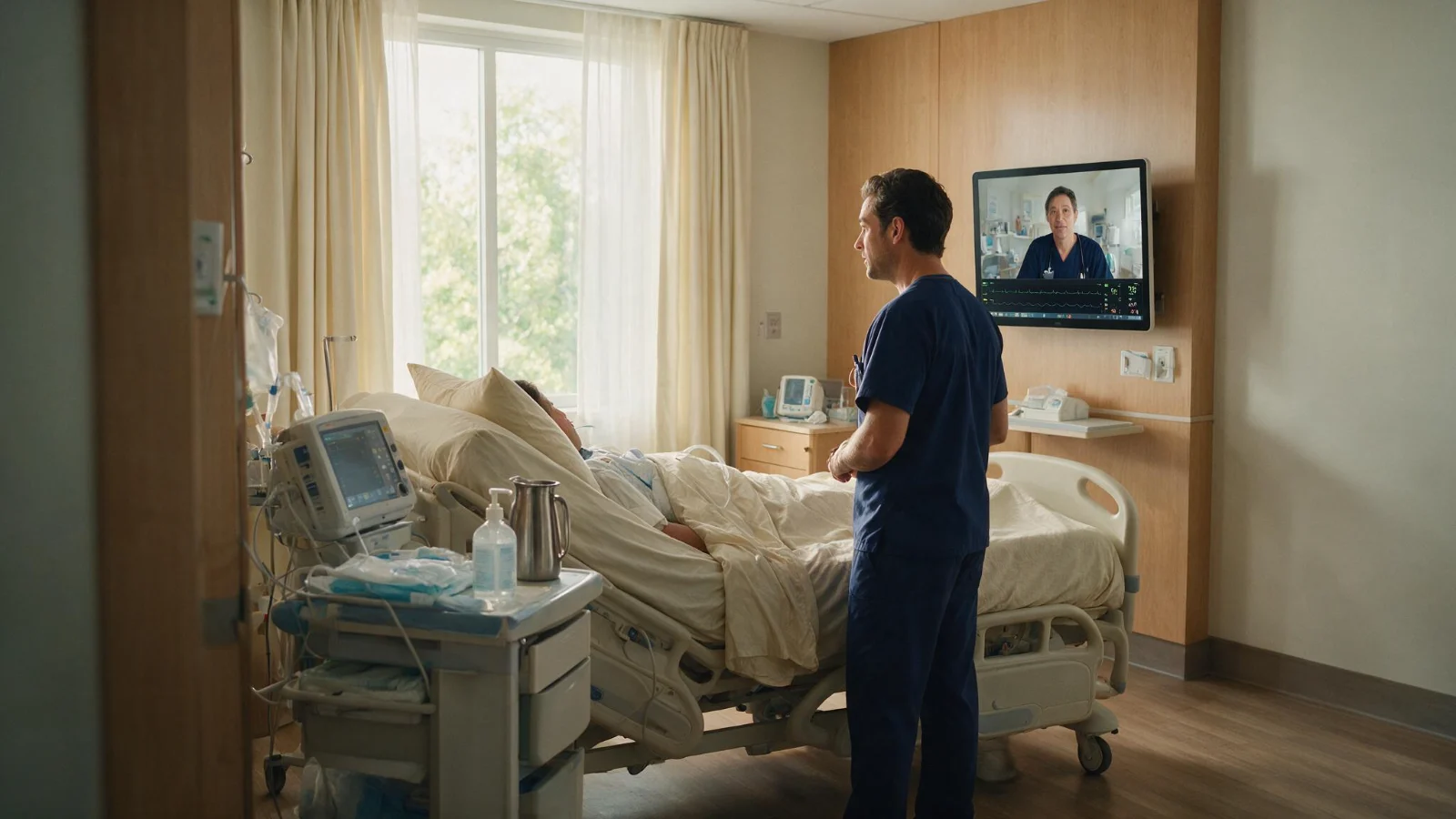
We often describe telemedicine primarily as a solution to an access problem. It allows a patient in one location to reach a clinician somewhere else, and that remains an essential part of its value. But access to a clinician is only one form of access. There is also access to expertise.
A Different Way to Think About Telemedicine
The more interesting question may be what happens when the right expertise can be present whenever uncertainty enters the room.
What presence changes
- For the patient, confidence that someone with the right experience is involved in their care.
- For the family, reassurance during moments that are already frightening.
- For the clinician, a rare or unfamiliar case no longer has to be managed alone.
That is why I have come to think of telemedicine, in part, as a treatment for anxiety across the healthcare system. Its value is not limited to connecting people across distance. It can connect uncertainty with experience, helping clinicians make better decisions while allowing more patients to receive appropriate care where they already are.
We have been paying the hidden cost of clinical anxiety for a long time
Telemedicine gives us a powerful way to reduce it.
FAQ
What is clinical anxiety in this context?
It is the uncertainty a clinician feels facing a situation they are trained for but rarely encounter. The gap is not knowledge but repetition: when a serious event happens roughly once a year, the steps never become reflexive, and the decision is made under pressure rather than from habit.
Isn't a written protocol enough?
A protocol tells a clinician what to do. It does not supply the confidence that comes from having someone who has managed the situation many times before present while the decision is being made. In stroke care especially, the difference between having a protocol and having a specialist on the call is the difference between following steps and being guided through them.
What does clinical uncertainty actually cost?
Inappropriate treatment, unnecessary transfers, and escalation of care that was avoidable. Some of those costs are financial; others show up in staffing, capacity, patient experience, and outcomes. Most never appear cleanly as a line item, which is why they persist.
How is access to expertise different from access to a clinician?
Access to a clinician connects a patient in one location to someone qualified somewhere else. Access to expertise connects the clinician already caring for the patient to deeper experience in the specific situation in front of them, often without the patient going anywhere.
Does this mean fewer transfers?
Frequently, yes. When the expertise required to feel confident is available immediately, more patients can be treated appropriately where they already are, and facilities can keep operating rather than moving patients out of an abundance of caution.
Where does this pattern apply beyond radiology?
Anywhere a low-frequency, high-consequence event meets a generalist. Contrast reactions in imaging centers, thrombolytics in the emergency department, and unfamiliar infectious disease regimens at the bedside are the clearest examples, but the pattern repeats across the continuum.