


A nursing care model is the framework a health system uses to decide who delivers care, where they deliver it, and how work gets divided among the team. A staffing model built around headcount and unit type is running up against ongoing staffing challenges and a facility landscape that no longer stops at a single building's walls, one where care increasingly extends beyond a nurse's physical presence. That's why nurse staffing ratios and workload redistribution have both become central to how health systems are rethinking care delivery.
Key Takeaways
- Ratios set by patient location and unit type, rather than by acuity and patient need, are what nurse leaders describe as fundamentally broken about the current model.
- Redesign begins with the task list, not the org chart: admissions, compliance documentation, and second verification of medications move first.
- Consolidation, hospital-at-home, and outcome-based Medicare payment are changing the landscape faster than staffing models are changing.
- The two workable team-based models, nurses floating between virtual and bedside shifts or experienced nurses specializing virtually, both keep virtual work clinical rather than observational.
- A 2025 JAMA Network Open study found more than half of bedside nurses saw no workload reduction after virtual nursing, absent adequate staffing and defined roles.
- Name the problem, collect pre-implementation data, and build the team before the workflow. Technology purchase is not step one.
That number gets the attention of a finance committee, though nurse leaders say the real story is upstream of the spreadsheet.
Where today's nurse staffing ratios break down
When nurse leadership starts really looking at why nurses are turning over, they start to see that there's burnout. And when we start to figure out why nurses are burning out, it's because they don't have the time to provide care to their professional standard. A nurse isn't ignoring a call light. They're busy doing other things.
 Marcia Murphy, MSN, RN, AGACNP-BC, ANP-BC, NE-BC, CCRN, CPHQChief Nursing Officer, Vitalchat
Murphy said health systems typically reach a breaking point in one of two ways: rising turnover that forces leadership to ask hard questions, or a sentinel event that exposes how overloaded a unit already was, both lagging indicators. The goal of a redesigned care model is to act on workload data before either happens. The pattern underneath both is usually nurse burnout, and the moral injury it's often mistaken for.
Elizabeth Glidewell, MSN, RN, CCRN, CAVRN, Director of Nursing, Clinical Innovation and Implementation at Vitalchat, points to the mechanics of how nurse staffing ratios get set in the first place.
Bedside staffing assignments are generally made using simple math. As the charge nurse, I know I have a certain number of patients and a certain number of nurses, and I divide that out to determine how many patients each nurse will be assigned for that shift. In the current staffing models, the nurse-to-patient ratio is determined by patient location and unit type, when really it should be based on patient acuity and patient needs. Assigning the right resources to the right patient is a fluid process and should not be based on math alone.
 Elizabeth Glidewell, MSN, RN, CCRN, CAVRNDirector of Nursing, Clinical Innovation and Implementation, Vitalchat
That mismatch, a ratio built on patient counts rather than patient acuity, is what nurse leaders describe as fundamentally broken about the current nursing care model. Fixing it starts with data and a strong charge nurse who can see, in the moment, when a patient or a unit needs more resources than the schedule assumed.
A landscape changing faster than staffing models
Staffing isn't the only thing under pressure. The environment around it is shifting too. Health systems are consolidating into larger networks, virtual and hospital-at-home programs are expanding, and Medicare payment models are moving from paying for visits to paying for outcomes.
Alan Pitt, MD, co-founder of Vitalchat, frames the shift around a single variable: distance.
If we can remove distance as a factor in the equation that gets us to quality care, what would you do?
 Alan Pitt, MDCo-founder, Vitalchat
For Pitt, that means getting a specialty consult dialed into a rural hospital in minutes rather than hours, without moving the patient at all.
Workload redistribution starts with care delivery, not the org chart
Inside this changing landscape, the most immediate work of nursing care model redesign is workload redistribution: determining which aspects of care genuinely require a nurse at the bedside and which non-nursing tasks have simply defaulted to nurses over time.
As patients have become sicker and acuity is much higher than it used to be, the care required has become much more complex, but we haven't changed the number of resources we've allocated. So the work is more, the staffing is less, and more falls to the nurse. Documentation burden alone is a prime example. You're doing the work, and then you're going back and documenting the work, sometimes in more than one place.
Elizabeth Glidewell, MSN, RN, CCRN, CAVRNDirector of Nursing, Clinical Innovation and Implementation, VitalchatHealth systems that have built virtual nursing programs tend to start with a short list of tasks that free up meaningful time without asking a bedside nurse to give anything up. Murphy pointed to admissions as a common first step. "That really does free up quite a lot of time for them to spend time with their patients," she said. Glidewell described handing off compliance documentation for central line bundles and infection-prevention checklists to a virtual nurse so the bedside team could stay focused on hands-on care. Both nurses also pointed to second verification of medications and blood products as work that is clearly nursing, whether it happens at the bedside or through a screen.
What a well-designed team-based nursing model actually looks like
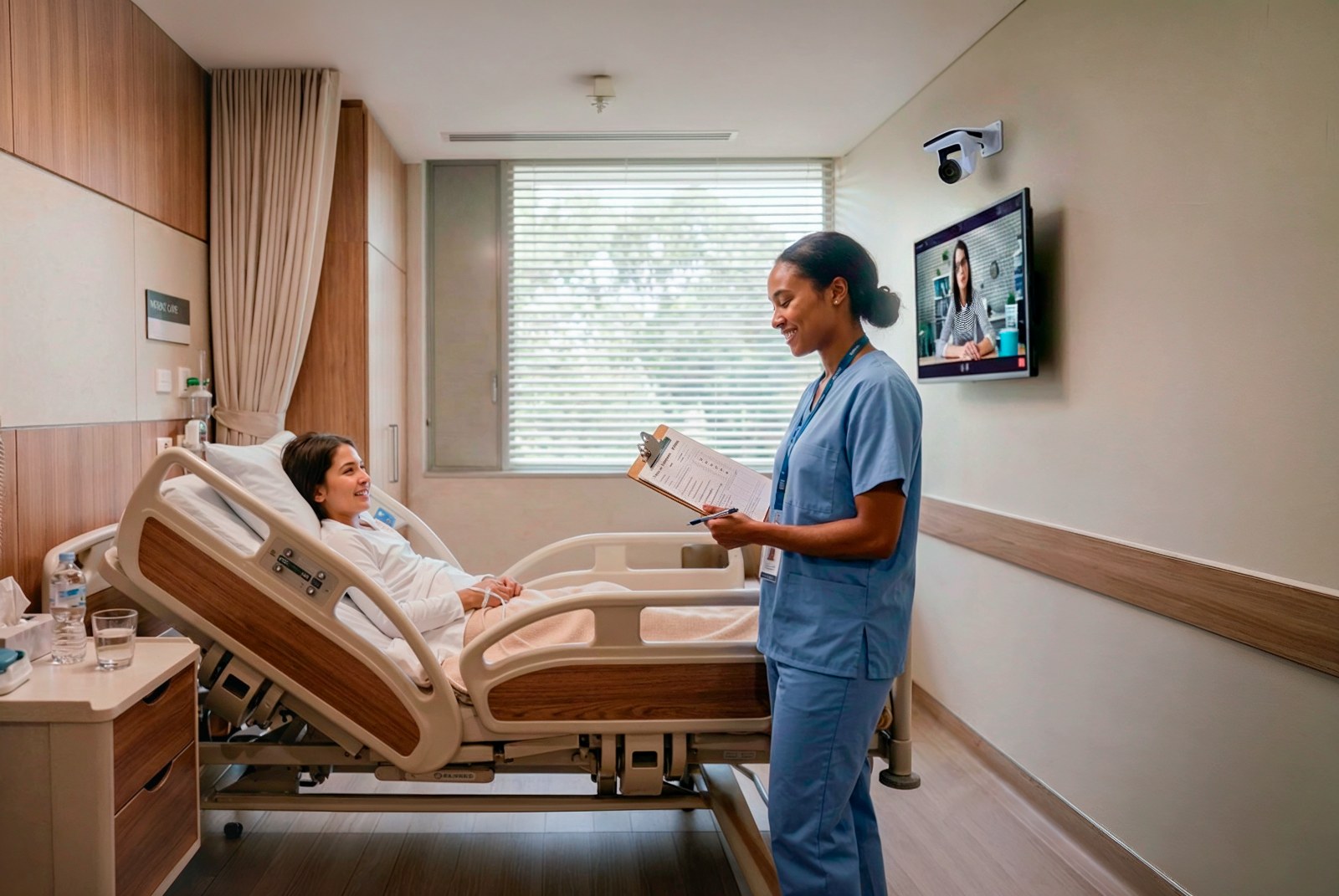
A well-designed model shares the workload across nursing staff, virtual and bedside, rather than splitting them into two separate departments. Certain nursing responsibilities, such as admissions, medication verification, and discharge coordination, can be handled successfully from either position. "It's still nursing work," Murphy said. "They should still be caring for patients."
Health systems have generally landed on one of two versions of this team-based nursing model, or some blend of them. In the first, nurses float between bedside and virtual shifts, which keeps their floor experience current and builds trust because the nurse on camera on Wednesday might be the nurse at the bedside on Thursday. In the second, experienced nurses specialize in virtual care full time and use that vantage point to mentor newer nurses on the floor, particularly during the stretch of a nurse's first year, when turnover runs highest. That second model also gives a nurse who can no longer sustain the physical demands of the floor, but who isn't ready to leave the profession, a way to extend a career instead of ending it, keeping decades of clinical judgment inside the building. Glidewell said the hybrid approach tends to produce the fastest, most durable adoption because bedside staff can see, firsthand, that the work happening in the virtual care center is clinical work rather than passive observation.
Change management is the actual project
Every nurse leader interviewed for this piece converged on the same answer when asked about the biggest mistake health systems make: leaving the people doing the work out of the redesign process.
Murphy named it directly: leaving out the clinicians who are actually providing the care today. "You have to include them," she said. "They're going to be the best people to tell you where the problems are, and they have ideas about how to solve them." Glidewell put it just as directly: "The biggest mistake you can make is not listening to your team, not hearing them when they say, this is the real problem, this is where I need help."
The workforce data explains why redesign is urgent. It doesn't automatically mean nurses trust the fix. A 2025 study of 880 bedside nurses across 10 states, published in JAMA Network Open, found that more than half reported no reduction in workload after their hospital adopted virtual nursing, and only 11% called the improvement in care quality substantial. The researchers concluded that virtual nursing programs are unlikely to meaningfully improve workload or care quality without sufficient bedside staffing and clearly defined roles.
That finding lines up with what Murphy and Glidewell described. Nurses consistently say they want virtual nurses to take genuine ownership of tasks such as admissions, discharge documentation, and patient education rather than simply observe. They want a defined scope of practice, so no one is guessing what a virtual colleague will or won't handle mid-shift. And they want virtual nursing treated as an addition to safe staffing rather than a justification for keeping fewer people on the unit. The American Nurses Association's 2025 Principles of Virtual Nursing put that last point plainly:
Virtual nurses should support, but not supplant, nurse staffing in nursing ratios, matrices, or other measures of staffing levels.
What erodes trust fastest is duplication. A virtual nurse who can't document directly in the electronic health record just hands the bedside nurse a second copy of the same work. That is the version of workload redistribution nurse leaders are working to avoid.
Where health systems see the fastest wins for patients
For patients, a redesigned care model shows up in moments long before it shows up in a spreadsheet. Murphy points to the seconds after a call button is pressed as one of the clearest moments of truth. "Having someone respond quickly and say, we got your message, what do you need, let me help you, that's a huge win," she said. She's also seen measurable gains in patient satisfaction scores from something as simple as using a virtual team to speed up meal tray and diet orders, so a patient admitted just before the kitchen closes isn't left waiting until the next meal.
Glidewell sees the same pattern in the time nurses can spend actually talking with patients. "The bedside nurses are so busy, they just don't have the time to dig as deep as they would like to when talking to patients," she said. "When you're using a virtual program, you have a real nurse on the other side of the screen who knows the questions to ask and has the resources and bandwidth to provide a solution."
Where to start
Nurse leaders were consistent on the first move for any health system ready to redesign its care model, and it isn't a technology purchase.
Name the specific problem before anything else
Is it turnover, throughput, length of stay, or readmissions? "You have to know what problem you're trying to solve," Murphy said. "It's exciting, it's something new, other people are doing it, and we want a virtual care program. But it's very important to focus on what problems we're actually trying to solve."
Collect pre-implementation data before making any changes
Glidewell called this the single most important step for proving out a program later. "Determine which metrics you will use to show the current problem and which you will use to prove success," she said. "You will want an apples-to-apples comparison of pre-implementation data and post-implementation data."
Build the team before building the workflow, and include finance and IT from the start
Resist the pressure to chase cost savings before the workflow is right. "There is a bit of an investment that happens up front," Murphy said. "You make sure you got it right first, that you're caring for patients well, and then you work on the efficiency and financial benefits."
That patience matters more given how little runway health systems have left. Nearly half the current nursing workforce is over 50, according to the National Council of State Boards of Nursing, and more than 1 million registered nurses are projected to retire by 2030, according to the International Council of Nurses, at the same time overall demand for nurses is expected to outstrip supply nationally.
See it in practice
Read how University Hospitals redesigned its care model with whole-hospital virtual nursing, and how North Mississippi Health Services built its virtual care program.
FAQ
What does it mean to redesign a hospital's care model?
Redesigning a care model means changing how work, staff, and technology are organized across a health system, typically by shifting which aspects of care require an in-person nurse, which can move to a virtual nurse or another team member, and how staffing is matched to patient acuity rather than a flat headcount.
What is virtual nursing and how does it fit into care model redesign?
Virtual nursing uses two-way audio and video so a remote registered nurse can support bedside care, handling nursing work such as admissions, discharge documentation, medication verification, and compliance checks. It's one of the main tools health systems use to redistribute workload without adding headcount, though nurse leaders emphasize it works best as an extension of bedside care.
How much does nurse turnover cost hospitals?
The average hospital loses roughly $4.2 million to $6.2 million a year to RN turnover, and turning over a single staff RN costs more than $60,000, according to the 2026 NSI National Health Care Retention and RN Staffing Report.
What is the first step in redesigning a care model?
Name the specific problem the redesign needs to solve, whether that's turnover, throughput, length of stay, or readmissions, then gather pre-implementation data so the results can be measured against a clear baseline before building out workflows and technology.
Does virtual nursing replace bedside nurses?
No. Nurse leaders interviewed for this piece were consistent that virtual nursing is designed to redistribute nursing work rather than eliminate nursing roles. The clearest results come from programs that keep virtual nurses doing genuine clinical work and involve bedside staff in designing the program from the start.
Sources
- Marcia Murphy, MSN, RN, AGACNP-BC, ANP-BC, NE-BC, CCRN, CPHQ, Chief Nursing Officer, Vitalchat. Interview, 2026.
- Elizabeth Glidewell, MSN, RN, CCRN, CAVRN, Director of Nursing, Clinical Innovation and Implementation, Vitalchat. Interview, 2026.
- Alan Pitt, MD, co-founder, Vitalchat. Interview, 2026.
- "The cost of nurse turnover in 10 points | 2026," Becker's Hospital Review.
- "CMS to launch payment model for expansion of technology-supported care access," AHA News.
- "The next generation of Medicare bundled payments: Considerations regarding TEAM," Milliman.
- "Nursing workforce crisis looms as expected six-million shortfall will be increased by more than four million nurses retiring by 2030," International Council of Nurses.
- NSI Nursing Solutions, "2026 NSI National Health Care Retention and RN Staffing Report."
- American Nurses Association, "Principles of Virtual Nursing," 2025.
- Muir, K.J., et al., "Virtual Nursing for the Care of Hospitalized Patients," JAMA Network Open, 2025.